
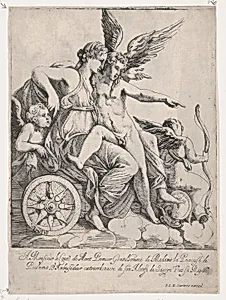
Venus and Cupid on a Chariot
Medium
Engraving
Dimensions
Sheet (trimmed): 9 5/16 × 6 3/4 in. (23.6 × 17.1 cm)
Classification
Prints
Department
Drawings and Prints
Museum
Metropolitan Museum of Art, New York, NY
Credit
The Elisha Whittelsey Collection, The Elisha Whittelsey Fund, 1961
Accession Number
61.658.10
Rights
Public Domain
Tags
Art Historical Context
This engraving, titled *Venus and Cupid on a Chariot*, captures a lively scene from classical mythology. The Roman goddess of love and her winged son ride together in a chariot, evoking themes of desire, beauty, and divine playfulness that captivated European audiences for centuries. Created between 1607 and 1661, the work reflects the enduring fascination with antique stories during the early modern period, when such subjects were frequently reinterpreted for new generations. The medium of engraving allowed artists to translate paintings and drawings into finely detailed prints that could be widely distributed. Here, the precise lines and tonal contrasts typical of the technique bring energy to the figures and their vehicle, making the mythological narrative accessible beyond the walls of private collections. Attributed in connection with both the Italian painter Girolamo Romanino and the French engraver Pierre Biard II, the print bridges regional artistic traditions. Now preserved in the Metropolitan Museum of Art’s Drawings and Prints department as part of the Elisha Whittelsey Collection, this work offers visitors a glimpse into how printmaking helped shape cultural memory of classical myths across Europe.