
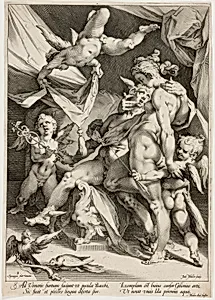
Venus and Mercury
c. 1600
Medium
Engraving in black on ivory laid paper
Dimensions
Image: 37.1 × 27.1 cm (14 5/8 × 10 11/16 in.); Plate: 39.5 × 27.7 cm (15 9/16 × 10 15/16 in.); Sheet: 39.5 × 28.3 cm (15 9/16 × 11 3/16 in.)
Classification
engraving
Department
Prints and Drawings
Museum
Art Institute of Chicago
Accession Number
233472
Rights
Public Domain
Art Historical Context
Step into the mythical realm with *Venus and Mercury*, an exquisite engraving by Jan Harmensz Muller, created around 1600. This Dutch, active during the late Renaissance and early Baroque transition, captures the Roman goddess of love, Venus, in playful interaction with the swift messenger god Mercury. Muller's precise lines evoke the elegance of classical mythology, a popular theme in Northern European art as artists drew inspiration from ancient stories to explore human emotions and divine whimsy. Crafted as a black-line engraving on creamy ivory laid paper—a high-quality support typical of the era—this work showcases Muller's virtuosic technique. Engraving involved incising intricate details into a copper plate, allowing for rich tonal contrasts and fine textures that brought reproductive prints to life, making art accessible beyond paintings. At 37.1 × 27.1 cm, the image balances grandeur with intimacy, reflecting the Haarlem school's Mannerist flair for elongated forms and dynamic poses, influenced by mentors like Hendrick Goltzius. Housed in the Art Institute of Chicago's Prints and Drawings Department, this piece highlights the print's role in 17th-century cultural exchange, bridging Antwerp's innovations with Amsterdam's rising prominence. A testament to technical prowess and timeless allure, it invites visitors to ponder the gods' eternal dance.
About the Artist
Jan Harmensz. Muller · 1571–1628
Comment on works: Printer and Draughtsman