
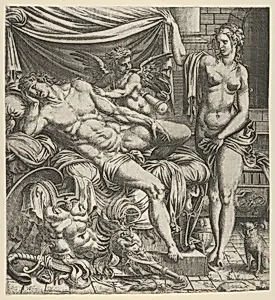
Venus Finding Mars Asleep
ca. 1545
Medium
Etching
Dimensions
Sheet (trimmed): 11 11/16 × 10 7/8 in. (29.7 × 27.6 cm)
Classification
Prints
Department
Drawings and Prints
Museum
Metropolitan Museum of Art, New York, NY
Credit
The Elisha Whittelsey Collection, The Elisha Whittelsey Fund, 1949
Accession Number
49.95.180
Rights
Public Domain
Tags
Art Historical Context
This elegant etching, created around 1545, captures a mythological moment in which Venus, goddess of love, discovers the slumbering Mars, god of war. Designed by the Italian artist Luca Penni and executed by the French printmaker Léon Davent, the scene includes playful putti (often described as angels) and animals, infusing the classical tale with graceful, elongated figures typical of Mannerism. The work emerged from the School of Fontainebleau, where Italian artists like Penni were invited by King Francis I to decorate the French royal palace. This collaboration blended High Renaissance ideals with a distinctive French courtly elegance, producing sophisticated compositions that celebrated both mythology and refined sensuality. Prints such as this one were vital in spreading Fontainebleau’s innovative style across Europe. Etching, still a relatively new technique in the mid-16th century, allowed Davent to achieve fluid, painterly lines that convey movement and atmosphere more freely than traditional engraving. By reproducing Penni’s designs, these prints made the opulent visual language of the French court accessible to a wider audience, helping to shape European taste for generations. The result is both a technical achievement and a charming window onto Renaissance interpretations of ancient gods.
About the Artist
Luca Penni|Léon Davent · 1500–1557
Comment on works: Religious