
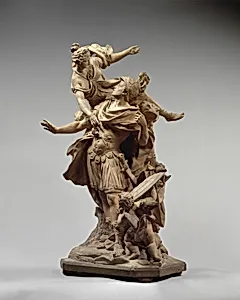
Venus Giving Arms to Aeneas
1704
Medium
Terracotta and painted wood
Dimensions
H. 41-9/16 in. (108 cm)
Classification
Sculpture
Culture
French, Paris
Department
European Sculpture and Decorative Arts
Museum
Metropolitan Museum of Art, New York, NY
Credit
The Friedsam Collection, Bequest of Michael Friedsam, 1931
Accession Number
32.100.158
Rights
Public Domain
Tags
Art Historical Context
In the grand tradition of French Baroque sculpture, Jean Cornu's *Venus Giving Arms to Aeneas (1704) captures pivotal moment from Virgil's *Aeneid*. The goddess Venus, mother of the Trojan hero Aeneas, presents him with divine armor forged by Vulcan, symbolizing maternal protection and destiny's call as Aeneas founds Rome. Often accompanied by the mischievous Cupid, this mythological scene reflects the era's fascination with classical epics, blending heroism with tender familial bonds. Crafted from terracotta—fired clay prized for its malleability and expressive surfaces—and painted wood for vivid detailing, the sculpture stands over 41 inches tall. Cornu, a Paris-based artist active under Louis XIV's opulent court, employs dynamic poses and flowing drapery typical of the late Baroque style, transitioning toward the lighter Rococo. The mixed media allowed for rich polychromy, bringing the figures' emotions and textures to life in a way marble could not. Housed in The Metropolitan Museum of Art's European Sculpture and Decorative Arts Department as part of The Friedsam Collection, this work highlights early 18th-century French virtuosity. It invites visitors to ponder how ancient myths fueled royal propaganda and artistic innovation, evoking the splendor of Versailles-era ateliers.