
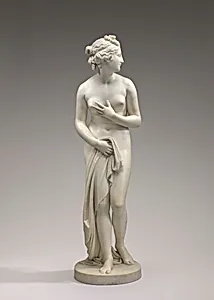
Venus
model 1817/1820, carved c. 1822/1823
Medium
marble
Dimensions
overall: 175.26 × 50.8 × 45.72 cm (69 × 20 × 18 in.) gross weight: 235.87 kg (520 lb.)
Classification
Sculpture
Department
CSD
Museum
National Gallery of Art, Washington, D.C.
Credit
Corcoran Collection (William A. Clark Collection)
Accession Number
2014.136.242
Rights
Public Domain
Art Historical Context
Behold the graceful *Venus*, a marble sculpture crafted after the renowned neoclassical master Antonio Canova. Modeled between 1817 and 1820 and carved around 1822–1823, this life-sized figure (standing nearly 69 inches tall and weighing over 520 pounds) captures timeless elegance of the goddess of love and beauty.ova, a pivotal figure in the Neoclassical movement, drew inspiration from ancient Greek and ideals, blending classical restraint with romantic vitality to revive antiquity's poise in the early 19th century. ble, the medium of choice for ancient masterpieces like the Venus de Milo, lends this work its luminous, tactile purity—polished to a silken sheen that invites viewers to trace Venus's gentle contours. As a studio version "after" Canova, it reflects the era's practice of producing high-quality replicas for collectors, disseminating his vision of feminine grace amid Europe's post-Napoleonic cultural renaissance. This piece, from the esteemed Corcoran Collection (William A. Clark Collection) at the National Gallery of Art, embodies Neoclassicism's quest to harmonize body and soul in sculptural form. Imagine Venus emerging from the block, her form a testament to Canova's technical genius in balancing mass and delicacy—a perfect emblem for museum-goers pondering beauty's enduring allure.