
Venus Rising from the Sea
Unknown Artist
19th century
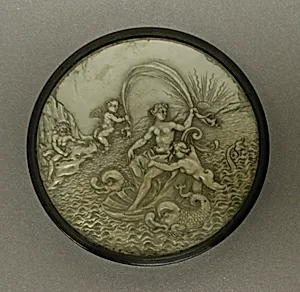
Medium
Disc: ivory; box: tortoiseshell
Dimensions
Diameter: 3 1/2 in. (8.9 cm)
Classification
Sculpture-Miniature
Culture
European
Department
European Sculpture and Decorative Arts
Museum
Metropolitan Museum of Art, New York, NY
Credit
Bequest of Stephen Whitney Phoenix, 1881
Accession Number
81.1.13
Rights
Public Domain
Tags
Art Historical Context
**Venus Rising from the Sea** enchanting 19th-century miniature sculpture the timeless myth of Venus, the Roman goddess of love, emerging from the sea foam in a moment of divine beauty. Carved from ivory on a delicate 3½-inch (8.9 cm) disc and housed in an ornate tortoiseshell box, the artwork features playful putti (cherubic figures), swirling fish, and radiant sun, evoking the classical theme of *Venus Anadyomene*. intricate vignettes were prized in European decorative arts, blending mythology with virtuoso craftsmanship. Ivory's smooth, luminous quality allowed artists to achieve lifelike textures and subtle modeling in miniature formats, a technique honed by European carvers during the Romantic era's fascination with antiquity. Tortoiseshell, sourced from hawksbill sea turtles, added exotic luxury, often inlaid or polished for jewelry boxes and curios—reflecting 19th-century tastes for portable, intimate art objects among the elite. Bequeathed to the Metropolitan Museum of Art in 1881 by Stephen Whitney Phoenix, this piece from the European Sculpture and Decorative Arts collection highlights the era's revival of Greco-Roman themes amid industrialization. Visitors, marvel at its tiny scale: a world of wonder in your palm! (198 words)