
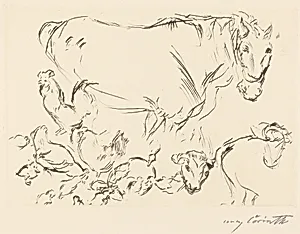
Verschiedene Tierstudien (Animal Studies)
1917
Medium
drypoint in black on J. W. Zanders laid paper
Dimensions
plate: 15 x 22 cm (5 7/8 x 8 11/16 in.) sheet: 26.2 x 35.1 cm (10 5/16 x 13 13/16 in.)
Classification
Department
CG-W
Museum
National Gallery of Art, Washington, D.C.
Credit
Gift of the Marcy Family in memory of Sigbert H. Marcy
Accession Number
1991.210.83
Rights
Public Domain
Art Historical Context
Lovis Corinth's *Verschiedene Tierstudien*Animal Studies), created in 1917, the artist's fascination with the natural world through a series of dynamic sketches. This drypoint print, executed in bold black lines on fine J. W. Zanders laid paper, measures a modest plate size of 15 x 22 cm. As a leading figure in German Expressionism, Corinth—known for his Impressionist roots evolving into raw, emotive after a 1911—produced these studies amid the turmoil of World War I, reflecting a personal retreat into observation and vitality. Drypoint, Corinth's favored intaglio technique, involves scratching directly into a copper plate, raising a soft burr that yields velvety, textured lines ideal for capturing the fluid energy of animals. This method allowed intimate, spontaneous studies, contrasting the era's mechanized horrors and highlighting Corinth's late-career mastery of printmaking. The laid paper's subtle texture enhances the print's tactile depth, a hallmark of high-quality early 20th-century European papers. Housed in the National Gallery of Art's Prints department (CG-W), this work was generously gifted by the Marcy Family in memory of Sigbert H. Marcy. It invites visitors to appreciate how Corinth transformed everyday motifs into profound expressions of life, bridging personal resilience with artistic innovation.
About the Artist
Lovis Corinth · 1858–1925
Lovis Corinth, born Franz Heinrich Louis on July 21, 1858, in Tapiau, East Prussia (now Gvardeysk, Russia), to a tanner father, displayed prodigious drawing talent from childhood. He began formal training at the Königsberg Academy in 1876, then moved to the Academy of Fine Arts in Munich from 1880 to 1884, studying under Ludwig von Löfftz and briefly Franz von Defregger, where he absorbed a Realis...