
Very Extravagant Verses
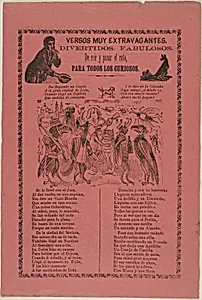
Medium
Double-sided relief engraving on typemetal on paper
Classification
woodcut
Department
Prints and Drawings
Museum
Art Institute of Chicago
Accession Number
52309
Rights
Public Domain
Art Historical Context
José Guadalupe Posada's *Very Extravagant Verses* (1903) is a captivating example of early 20th-century Mexican printmaking, housed in the Art Institute of Chicago's Prints and Drawings collection. Posada, a Mexican artist and illustrator (1852–1913), was renowned for his satirical broadsheets that blended sharp social commentary with the macabre imagery of *calaveras*—skeletal figures mocking the elite and everyday life. Created during Mexico's Porfirio Díaz era, this double-sided work likely features extravagant, humorous verses paired with Posada's signature bold, folk-inspired illustrations, critiquing extravagance amid widespread inequality. The medium—a relief engraving on typemetal transferred to paper, classified as a woodcut—highlights Posada's mastery of affordable, mass-reproducible techniques. Typemetal, a lead alloy used for printing plates, allowed for durable, high-contrast images ideal for cheap newsprint distributed in markets and streets. This process democratized art, making Posada's politically charged visuals accessible to the working class and influencing later Mexican muralists like Diego Rivera. Culturally, *Very Extravagant Verses* embodies the *calavera literaria* tradition, where witty poems and skeletons satirized vanity and power, foreshadowing modern Day of the Dead celebrations. Its double-sided format maximized impact, inviting viewers to engage from both sides—a testament to Posada's innovative, populist spirit.
About the Artist
José Guadalupe Posada · 1852–1913
José Guadalupe Posada (1852-1913) was a Mexican printmaker and engraver who revolutionized popular art and created some of the most iconic images in Mexican culture. Working primarily with publisher Antonio Vanegas Arroyo, he produced over 20,000 images during his career—inexpensive broadsheets sold for a penny on colored paper that made his art accessible to even the poorest workers. He transform...