
Vessel
Unknown Artist
12th–16th century (?)
Medium
Terracotta, slip
Dimensions
H. 7 1/4 x Diam. 4 3/8 in. (18.4 x 11.1 cm)
Classification
Ceramics-Containers
Culture
Middle Niger civilization
Department
Arts of Africa, Oceania, and the Americas
Museum
Metropolitan Museum of Art, New York, NY
Credit
Gift of Douglas Newton, 1986
Accession Number
1986.484.3
Rights
Public Domain
Art Historical Context
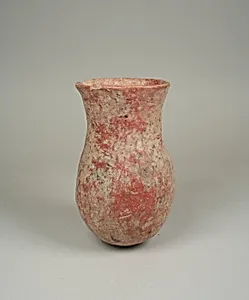
This elegant terracotta vessel hails from the Middle Niger in West Africa, likely dating to the 12th–16th century. Crafted by an unknown artisan in the Inland Niger Delta region (modern-day Mali), it exemplifies the sophisticated ceramic traditions of early urban societies that thrived along the Niger River. These communities were pioneers in rice cultivation, ironworking, and complex trade networks, and pottery like this vessel was essential for daily life—serving as containers for food storage, cooking, or rituals. Made from terracotta (fired clay) with a slip coating—a thin layer of liquid clay applied before firing for smoothness and decoration—the vessel measures a modest 7¼ inches high and 4⅜ inches in diameter. The slip technique not only enhanced durability and water resistance but also allowed for subtle surface finishes, highlighting the potter's skill in hand-building and low-fire methods suited to local clays. Now in the Metropolitan Museum of Art's Department of the Arts of Africa, Oceania, and the Americas (gift of Douglas Newton, 1986), this piece offers a window into a lesser-known chapter of African ingenuity. Its simple form belies the cultural richness of the Middle Niger peoples, whose ceramics bridged utility and artistry in pre-colonial West Africa.