
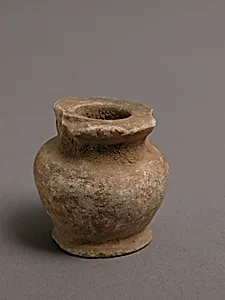
Vessel
Unknown Artist
4th–7th century
Medium
Stone
Dimensions
Overall: 1 7/16 x 1 3/8 in. (3.6 x 3.5 cm)
Classification
Lapidary Work
Culture
Coptic
Department
Medieval Art
Museum
Metropolitan Museum of Art, New York, NY
Credit
Rogers Fund, 1925
Accession Number
25.10.23.53
Rights
Public Domain
Art Historical Context
This delicate stone vessel, crafted by an unknown Coptic artist between the 4th and 7th centuries, exemplifies refined lapidary traditions of early Christian Egypt. Measuring just 1 7/16 x 1 3/8 inches (3.6 x 3.5 cm), it is a testament to the extraordinary skill of Coptic artisans, who carved hard stone into functional yet elegant objects. Acquired through the Rogers Fund in 5 and now housed in the Metropolitan of Art's Medieval Art, this tiny container likely served everyday or ritual purposes, such as holding oils, perfumes, orents. Coptic culture, flourishing in Egypt after the spread of Christianity, blended ancient Egyptian motifs with Greco-Roman and Byzantine influences. Lapidary work like this vessel highlights the period's mastery of stone carving—often using materials like alabaster or limestone—to create portable luxury items. These pieces were prized for their durability and intricate forms, reflecting a society where craftsmanship intertwined with spiritual life. Though small, this vessel offers a window into the vibrant world of late antique Egypt, where art bridged pagan traditions and emerging Christian iconography. Visitors are invited to marvel at its precision, a quiet survivor of a transformative era.