
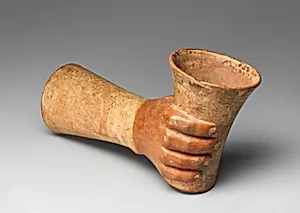
Vessel, Hand with Kero
15th–16th century
Medium
Ceramic, pigment
Dimensions
H. 10 5/16 x W. 3 1/2 x D. 5 1/2 in. (26.2 x 8.9 x 14 cm)
Classification
Ceramics-Containers
Culture
Inca (?)
Department
Arts of Africa, Oceania, and the Americas
Museum
Metropolitan Museum of Art, New York, NY
Credit
The Michael C. Rockefeller Memorial Collection, Bequest of Nelson A. Rockefeller, 1979
Accession Number
1979.206.1096
Rights
Public Domain
Tags
Art Historical Context
This striking ceramic vessel, titled *Vessel, Hand withero*, dates to the 15th–16th century and hails from Inca artist(s), possibly reflecting the vibrant pottery traditions of the Inca Empire in the Andes. Crafted from ceramic with pigment, it measures 10 5/16 x 3 1/2 x 5 1/2 inches, its form ingeniously shaped as a hand grasping a kero—a traditional Inca drinking cup used in rituals and social ceremonies. The hand motif, highlighted in the artwork's tags, evokes the human element central to Inca artistry, blending functionality with symbolic expression. Inca ceramics like this one were pivotal in daily and ceremonial life, often fired in kilns to achieve durable, glossy finishes enhanced by mineral pigments for vivid colors. Produced during the empire's peak and the eve of Spanish contact, such vessels showcase the Inca mastery of modeling clay into anthropomorphic shapes, conveying cultural narratives of community, offering, or reverence for the body. Though its exact provenance bears a question mark, it aligns with Inca innovations in container forms that served both practical and prestige purposes. Now part of The Michael C. Rockefeller Memorial Collection at The Metropolitan Museum of Art, this piece invites us to ponder the Inca worldview—where everyday objects pulsed with profound meaning. A testament to pre-Columbian ingenuity, it bridges art and ritual in the Arts of Africa, Oceania, and the Americas department.