
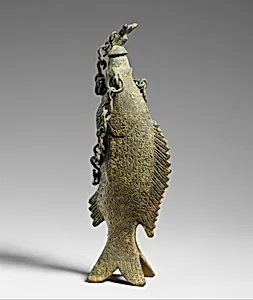
Vessel in the Shape of a Fish
Unknown Artist
4th–6th century
Medium
Copper alloy, cast
Dimensions
Overall (vessel only standing on tail): 8 13/16 x 2 13/16 x 1 5/8 in. (22.4 x 7.1 x 4.1 cm) with chain suspended: 11 13/16 x 2 13/16 x 1 5/8 in. (30 x 7.1 x 4.1 cm)
Classification
Metalwork-Copper alloy
Culture
Roman or Byzantine
Department
Medieval Art
Museum
Metropolitan Museum of Art, New York, NY
Credit
Fletcher Fund, 1962
Accession Number
62.10.4
Rights
Public Domain
Tags
Art Historical Context
This enchanting *Vessel in the Shape of a Fish*, crafted from cast copper alloy around the 4th–6th century, captures the whimsical artistry of late Roman or early Byzantine metalworkers. Standing on its tail at just under 9 inches tall (or 12 inches with its suspension chain), the vessel's sleek, naturalistic form evokes a fish gliding through water, with finely detailed fins, scales, and an open mouth that likely served as a spout for pouring liquids—perhaps oil, perfume, or wine. Dating to the transitional era between the Roman Empire and the rise of Byzantium, this piece reflects the enduring Roman love for zoomorphic objects, blending functionality with symbolism. Fish motifs were common in Mediterranean cultures, possibly alluding to abundance, the sea's bounty, or even early Christian iconography like the ichthys. Housed in the Metropolitan Museum of Art's Medieval Art department (Fletcher Fund, 1962), it exemplifies the sophisticated lost-wax casting techniques that allowed artisans to create hollow, intricate forms from durable copper alloy. For visitors, this diminutive treasure highlights the everyday elegance of ancient life, where even practical items became sculptural delights. Marvel at how its chain suggests it once dangled gracefully, perhaps in a grand villa or basilica.