
Viaduct, Coal Pockets
1908
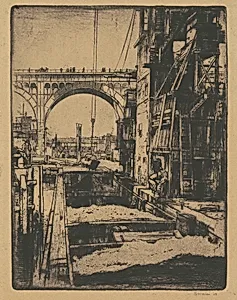
Medium
etching in black on wove paper
Dimensions
plate: 25.24 × 19.05 cm (9 15/16 × 7 1/2 in.) sheet: 28.26 × 21.59 cm (11 1/8 × 8 1/2 in.)
Classification
Department
CG-W
Museum
National Gallery of Art, Washington, D.C.
Credit
Corcoran Collection (Bequest of Frank B. Bristow)
Accession Number
2015.19.1535
Rights
Public Domain
Art Historical Context
Step into the gritty dynamism of early 20th American industry with Earl Horter's *Viaduct, Coal Pockets* (1908), a masterful etching that captures towering viaducts and coal storage pockets against an urban skyline. Created during the height of America's industrial boom, this print reflects the era's fascination with rapid modernization, where railroads and coal fueled economic expansion. Horter, a-based artist known for his renderings of machinery and cityscapes, invites viewers to marvel at the skeletal beauty of infrastructure often overlooked in fine art. Rendered in black ink on smooth wove paper, the etching technique—where acid bites intricate lines into a metal plate—allows Horter to achieve sharp contrasts and fine details, emphasizing the geometric forms and textures of steel and stone. Measuring just under 10 by 7.5 inches on the plate, its intimate scale draws the eye into the scene's mechanical poetry, a hallmark of early modernist printmaking that made complex subjects accessible. Today, this work resides in the National Gallery of Art's Corcoran Collection (Bequest of Frank B. Bristow), celebrating the legacy of American printmakers who documented a transforming nation. A testament to Horter's skill, it reminds us how art can transform the mundane into the monumental.