
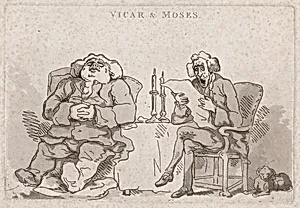
Vicar & Moses
Medium
Etching and aquatint; before publication line
Dimensions
Plate: 5 5/8 × 8 1/4 in. (14.3 × 20.9 cm) Sheet: 8 1/4 × 11 3/8 in. (21 × 28.9 cm)
Classification
Prints
Department
Drawings and Prints
Museum
Metropolitan Museum of Art, New York, NY
Credit
The Elisha Whittelsey Collection, The Elisha Whittelsey Fund and Harris Brisbane Dick Fund, by Exchange, 1970
Accession Number
1970.541.21
Rights
Public Domain
Tags
Art Historical Context
**Vicar & Moses**, a satirical etching and aquatint from1786 by Thomas Rowland in collaboration with publisher William Holland, captures the spirit of Georgian-era caricature. Rowlandson, a master of British satire, delighted audiences with his witty jabs at social follies, often featuring exaggerated figures in everyday absurdities. This proof state—before the final publication lines—offers a rare glimpse into the printmaking process highlighting the fluidity of etching for bold lines and aquatint for subtle tonal effects, which lent his works their lively, hand-drawn charm. The scene humorously unites a dozing vicar and his dog Moses, poking fun at clerical complacency amid the bustling satirical print culture of late 18th-century London. Affordable prints like this one, produced in small plates (5 5/8 × 8 1/4 in.), flooded taverns and homes, amplifying Rowlandson's critique of manners, religion, and class. Tags of "Satire, Sleeping, Men, Dogs" evoke a cozy yet comical domestic mishap, reflecting the era's fondness for anthropomorphic pets and human foibles. Housed in the Metropolitan Museum of Art's Drawings and Prints department through the Elisha Whittelsey Collection, this piece exemplifies how satire shaped public discourse, blending artistry with sharp social commentary for enduring appeal.
About the Artist
Thomas Rowlandson|William Holland · 1756–1827
Thomas Rowlandson (1757–1827) was an English artist and caricaturist whose satirical watercolors and prints captured the social life of Georgian Britain with unparalleled wit and technical mastery. Alongside James Gillray, he is recognized as one of the greatest British graphic artists, and his distinctive flowing line and keen observations have made his work integral to understanding late 18th an...