
Vicksburg Canal
Medium
Classification
Department
Smithsonian Collection
Museum
Smithsonian American Art Museum
Credit
National Portrait Gallery, Smithsonian Institution
Accession Number
NPG.79.95.Y
Rights
Public Domain
Tags
Art Historical Context
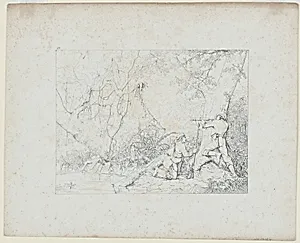
**Vicksburg Canal** is a compelling 1864 print byalbert John Volck a German-born artist and dentist who lived from 1828 to 1912. Created amid the American Civil War, this belongs to the Smithsonian American Art Museum's collection, in the National Portrait Gallery Volck was known for his pro-Confederate etchings often produced clandestinely in Baltimore under pseudonyms to evade Union censorship. As a print—a medium ideal for quick dissemination of political satire—this piece captures the tense atmosphere of the Siege of Vicksburg, a pivotal 1863 campaign where Union forces under General Ulysses S. Grant attempted to bypass Confederate defenses by digging a canal along the Mississippi River. The artwork's tags—hat, exterior, tree, portrait, pistol, rifle—evoke an outdoor military scene, likely portraying soldiers or a key figure amid the Mississippi landscape. Volck's etched lines would have rendered sharp details, blending portraiture with caricature to mock Union efforts or highlight Southern resilience. Vicksburg's fall marked a turning point, splitting the Confederacy and securing Union control of the river, making this print a poignant artifact of wartime propaganda. Today, it offers museum visitors insight into how art fueled division, showcasing Volck's technical skill in printmaking to rally Confederate spirits. A testament to 19th-century dissent, it reminds us of art's power in shaping history. (198 words)