
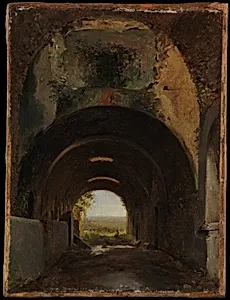
View in the Stables of the Villa of Maecenas, Tivoli
ca. 1805–10
Medium
Oil on paper, laid down on canvas
Dimensions
10 1/2 x 8 3/4 in. (26.7 x 22.2 cm)
Classification
Paintings
Department
European Paintings
Museum
Metropolitan Museum of Art, New York, NY
Credit
Gift of Eugene V. Thaw, 2007
Accession Number
2007.164.3
Rights
Public Domain
Tags
About this artwork
"View in the Stables of the Villa of Maecenas, Tivoli" by François Marius Granet, created in ca. 1805–10, is executed in oil on paper, laid down on canvas. This paintings belongs to the Metropolitan Museum's European Paintings collection. The work measures 10 1/2 x 8 3/4 in. (26.7 x 22.2 cm). The artwork entered the museum's collection through gift of eugene v. thaw, 2007.
Art Historical Context
Step into the shadowed arches of ancient Rome with François Marius Granet's *View in the Stables the Villa of Maecenas Tivoli* (ca. 1805–10). This petite oil on paper, laid down on canvas—measuring just 10½ × 8¾ inches—captures the evocative ruins of the Villa of Maecenas, a lavish estate built by Gaius Maecenas, the Roman patron of poets like Virgil and Horace during Augustus's reign. Nestled in Tivoli near Rome, the site's crumbling stables evoke the grandeur and transience of imperial life, their arches framing a timeless interplay of light and stone. Granet, a French painter celebrated for his luminous depictions of Italian architecture and landscapes, crafted this work during his extended stay in Rome amid the Napoleonic era's cultural fervor. His precise yet atmospheric style reflects a Romantic fascination with antiquity, blending Neoclassical clarity with emotional depth. The unusual medium of oil on paper suggests a spontaneous study, possibly executed on-site, highlighting early 19th-century innovations in portable sketching that influenced later plein-air traditions. Today, this gem graces the Metropolitan Museum of Art's European Paintings collection, a 2007 gift from Eugene V. Thaw. It invites visitors to ponder how 2,000-year-old arches still whisper stories of patronage and decay, bridging ancient patronage with modern artistry.