
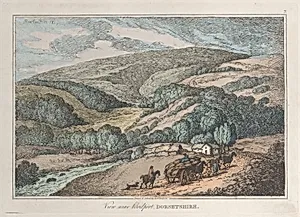
View near Bridport, Dorsetshire
1819–22
Medium
Hand-colored etching
Dimensions
Plate: 6 7/8 × 9 5/8 in. (17.5 × 24.5 cm) Sheet: 7 7/8 × 10 5/16 in. (20 × 26.2 cm)
Classification
Prints
Department
Drawings and Prints
Museum
Metropolitan Museum of Art, New York, NY
Credit
The Elisha Whittelsey Collection, The Elisha Whittelsey Fund, 1959
Accession Number
59.533.1644(11)
Rights
Public Domain
Tags
Art Historical Context
Thomas Rowlandson’s “View near Bridport, Dorsetshire” captures a tranquil stretch of the English countryside in the early nineteenth century. Created between 1819 and1822, the hand-colored etching presents rolling hills, scattered trees, and a winding road that invites the viewer to imagine traveling through Dorset’s pastoral landscape Although Rowlandson is best known for his lively caricatures and social satire, this print reveals his quieter appreciation for topography and the natural world. As a hand-colored etching, the work combines the precision of printmaking with the personal touch of watercolor. Etchings like this one allowed artists to produce multiple impressions that could be colored individually, making scenic views accessible to a growing middle-class audience. The modest plate size—roughly 7 by 10 inches—further suggests the print was intended for private albums or travel books rather than grand display. Today the sheet forms part of the Metropolitan Museum’s Elisha Whittelsey Collection, preserving a moment when British artists turned their attention to the beauty of their own countryside. Its gentle lines and soft palette continue to offer visitors a window onto both the geography and the artistic spirit of Regency England.
About the Artist
Thomas Rowlandson · 1756–1827
Thomas Rowlandson (1757–1827) was an English artist and caricaturist whose satirical watercolors and prints captured the social life of Georgian Britain with unparalleled wit and technical mastery. Alongside James Gillray, he is recognized as one of the greatest British graphic artists, and his distinctive flowing line and keen observations have made his work integral to understanding late 18th an...