
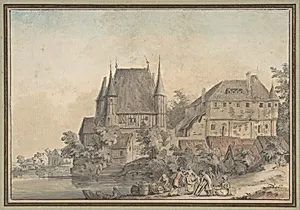
View of a Village alongside a River
Medium
Pen and dark gray ink, brush and gray wash, watercolor
Dimensions
sheet: 4 9/16 x 6 11/16 in. (11.6 x 17 cm)
Classification
Drawings
Department
Drawings and Prints
Museum
Metropolitan Museum of Art, New York, NY
Credit
Gift of Alexander B.V. Johnson and Roberta J.M. Olson, in memory of Laurie Vance and Edward Dudley Hume Johnson, 2001
Accession Number
2001.751.2
Rights
Public Domain
Tags
Art Historical Context
Samuel Hieronymus Grimm's *View of a Village alongside a* (1766) captures the serene beauty of an 18th-century rural landscape, likely inspired by British countryside scenes. This intimate drawing depicts a cluster of quaint houses lining a winding river, dotted with human figures going about daily life—perhaps villagers at work or leisure. At just 4 9/16 x 6 11/16 inches, it invites close inspection, evoking the charm of a peaceful hamlet frozen in time. Swiss-born Grimm, who settled in England around 1768, was a prolific topographical artist renowned for his meticulous documentation of landscapes, antiquities, and architecture. Working during the Enlightenment era's fascination with empirical observation and national heritage, his works served as valuable records before widespread photography. This piece exemplifies his contribution to British topographical art, blending precision with subtle atmosphere to preserve everyday scenes amid rapid industrialization. Crafted in pen and dark gray ink for sharp outlines, enhanced by brush and gray wash plus watercolor for tonal depth and soft highlights, the medium highlights Grimm's skill in mixed techniques. Housed in the Metropolitan Museum of Art's Drawings and Prints department, this gift from 2001 underscores its enduring appeal as a window into 18th-century life.