
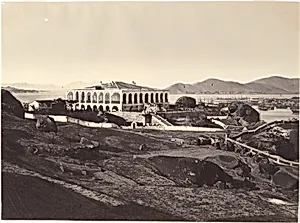
View of Amoy
ca. 1869
Medium
Albumen silver print from glass negative
Dimensions
Image: 7 1/2 × 10 1/16 in. (19 × 25.5 cm)
Classification
Photographs
Department
Photographs
Museum
Metropolitan Museum of Art, New York, NY
Credit
Gilman Collection, Purchase, Robert Rosenkranz Gift, 2005
Accession Number
2005.100.494.86
Rights
Public Domain
Tags
Art Historical Context
**View of Amoy** (ca. 1869) by John Thomson captures the bustling harbor city of Amoy—now known as Xiamen, China—in a striking albumen silver print from a glass negative. Measuring 7½ × 10⅛ inches, this photograph showcases Thomson's mastery of early photography, a medium that revolutionized visual documentation in the mid-19th century.en prints, coated with egg whites and sensitized with silver salts, produced richly toned images with fine detail, ideal for preserving distant landscapes like this panoramic vista of buildings and waterfront. Thomson, a pioneering Scottish photographer and explorer, traveled extensively through China and Southeast Asia during the 1860s and 1870s, creating one of the first comprehensive photographic records of the region. Taken amid Western colonial expansion and the Opium Wars' aftermath, *View of Amoy* offers a window into a thriving trading port, blending traditional Chinese architecture with maritime activity. Its historical significance lies in bridging East and West, providing invaluable visual ethnography at a time when photography was still a novel technology. This work, part of the Metropolitan Museum of Art's Gilman Collection, highlights how 19th-century photographs like Thomson's not only documented exotic locales but also shaped global perceptions of Asia, inviting viewers to ponder the era's cultural exchanges and imperial gazes.
About the Artist
John Thomson · 1837–1921
John Thomson (1837–1921), a pioneering Scottish photographer, was born on 14 June 1837 in Edinburgh as the eighth of nine children to William Thomson, a tobacco spinner and trader, and Isabella Newlands.) After schooling in the early 1850s, he apprenticed with a local optical and scientific instrument manufacturer, where he mastered the principles of photography, completing his training around 185...