
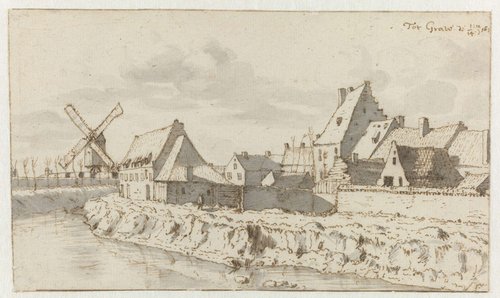
View of Grave, Noord-Brabant
1674 - 1676
Medium
pen and brown ink, with grey wash, over traces of graphite; framing line in brown ink
Dimensions
95; 161
Rights
Public Domain
About this artwork
…; ? acquired by the museum (L. 2228), in or after 1921;{According to L. 2228.} first recorded in the museum in 1973 (as Josua de Grave){RMA inventory book of ‘uninventoried drawings’.}
Art Historical Context
**View of Grave, Noordrabant** by Barend Klotz (c. 1635–1704) captures a precise topographical vista of the Dutch fortress town of Grave in North Brabant, between 1674 and 1676. Klotz, a Dutch Age draughtsman renowned for his detailed architectural and landscape studies, likely created this work during a turbulent period marked by the Franco-Dutch War. Grave, a strategic stronghold, fell to French forces in 1674 after a fierce siege, adding layers of historical intrigue to this intimate scene—perhaps evoking the town's resilient fortifications amid wartime upheaval. Executed on a modest scale (95 × 161 mm), the drawing employs pen and brown ink with grey wash over faint graphite underdrawing, heightened by a framing line in brown ink. This meticulous mixed-media technique was prized in 17th-century Holland for its versatility, allowing artists like Klotz to achieve subtle tonal depth and atmospheric effects in preparatory sketches or standalone views. Such works highlight the era's fascination with accurate depiction of the homeland, blending documentary precision with artistic finesse. Acquired by the museum (Lugt 2228) in or after 1921 and first cataloged in 1973—initially misattributed to Josua de Grave—this rare Klotz sheet offers visitors a window into Dutch topographic artistry and the enduring allure of vanishing landscapes.