
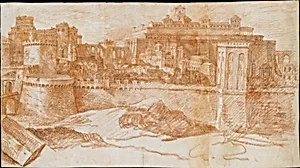
View of Jerusalem with the Temple of Solomon
17th century
Medium
Red chalk on two attached sheets of off-white laid paper
Dimensions
13 1/16 x 23 3/4 in. (33.1 x 60.3 cm)
Classification
Drawings
Department
Drawings and Prints
Museum
Metropolitan Museum of Art, New York, NY
Credit
Purchase, 2002 Benefit Fund and Gift of Dr. Mortimer D. Sackler, Theresa Sackler and Family, 2004
Accession Number
2004.138
Rights
Public Domain
Tags
Art Historical Context
This evocative red chalk drawing by Philippe de Champaigne captures an imagined vista of ancient Jerusalem centered on the Temple of Solomon. A leading French Baroque artist of the seventeenth century, Champaigne was renowned for his precise draftsmanship and religious subjects, often infusing them with a sense of solemn grandeur influenced by his Flemish roots and close ties to the Jansenist movement. Created on two joined sheets of laid paper, the work’s panoramic format allows for an expansive, almost topographical rendering that blends architectural fantasy with devotional intent. The choice of red chalk—a medium prized during the Baroque era for its warm tonal range and capacity for delicate modeling—lends the scene a luminous, almost sculptural quality. Visitors can appreciate how Champaigne used subtle hatching and soft gradations to suggest both the monumental temple and the surrounding Judean landscape, transforming a biblical motif into a tangible, contemplative space. Acquired by the Metropolitan Museum in 2004, the drawing offers a rare glimpse into the preparatory or exploratory side of a master painter whose finished canvases grace many European collections. Beyond its technical refinement, the sheet reflects the period’s enduring fascination with sacred history and the desire to visualize holy sites that no longer existed in their original form. It invites viewers to consider how seventeenth-century artists bridged scripture, archaeology, and imagination to bring the distant past vividly to life.
About the Artist
Philippe de Champaigne · 1602–1674
He was known as one of the greatest portrait painters of 17th-century France. His art was based in an analytical study of appearances and on psychological truth. He was also one of the principal instigators of the Classical tendency and a founder-member of the Académie Royale de Peinture et de Sculpture. He developed an interest in Jansenist thinking, typified by a severe plainness of style. His ...