
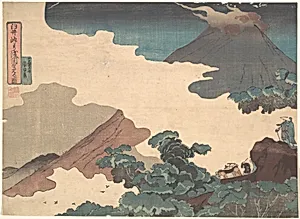
View of Mt. Asama from the Usui Pass
ca. 1850
Medium
Woodblock print; ink and color on paper
Dimensions
H. 10 1/8 in. (25.7 cm); W. 14 in. (35.6 cm)
Classification
Prints
Culture & Period
Japan · Edo period (1615–1868)
Department
Asian Art
Museum
Metropolitan Museum of Art, New York, NY
Credit
Rogers Fund, 1922
Accession Number
JP1424
Rights
Public Domain
Tags
Art Historical Context
This evocative woodblock print by Utagawa Kuniyoshi captures a sweeping view of Mount Asama, Japan’s famously active volcano, as seen from the historic Usui Pass. Created around 1850 during the late Edo period, the work exemplifies the ukiyo-e tradition of landscape imagery that flourished as travel became more accessible. Kuniyoshi, celebrated for his dynamic compositions and bold use of color, here turns his attention to nature’s grandeur, balancing the imposing volcanic peak with delicate clusters of trees in the foreground. Printed with ink and color on paper, the medium allowed for vibrant yet reproducible details that brought distant scenic wonders into homes and collections across Japan. At roughly 10 by 14 inches, the compact format was ideal for the popular print market of the time. The scene subtly reflects the Edo-era fascination with Japan’s dramatic topography, where volcanoes symbolized both beauty and the unpredictable forces of nature. Today in the Metropolitan Museum of Art’s Asian Art collection, the print offers modern viewers a glimpse into 19th-century Japanese appreciation for travel and the natural world, rendered through the refined techniques of woodblock artistry.
About the Artist
Utagawa Kuniyoshi · 1797–1861
Utagawa Kuniyoshi (1797–1861) was born in Edo to the silk-dyer Yanagiya Kichiyemon, originally bearing the childhood name Yoshisaburō. From a young age, he assisted in his family's pattern design work, which sharpened his innate mastery of color and textile motifs that would permeate his later prints. At around twelve years old, his prodigious drawing skills drew the attention of the renowned Utag...