
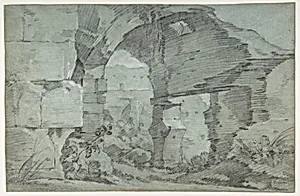
View of the Colosseum
ca. 1744–50
Medium
Black and white chalk on blue antique laid paper
Dimensions
11 3/4 x 18 1/16 in. (29.8 x 45.9 cm.)
Classification
Drawings
Department
Drawings and Prints
Museum
Metropolitan Museum of Art, New York, NY
Credit
Harry G. Sperling Fund, 2003
Accession Number
2003.324
Rights
Public Domain
Tags
Art Historical Context
Joseph Marie Vien's *View of the Colosse*, created around 1744–50, captures the majestic ruins of Rome's iconic amphitheater in a drawing executed in black and white chalk on antique laid paper. Measuring just under 12 by 18 inches, this intimate study showcases Vien's keen eye for architectural grandeur during his formative years in Italy. As a young French artist on the Grand Tour—a rite of passage for 18th-century European creatives—this sketch reflects the era's fascination with classical antiquity, where ruins like the Colosseum symbolized the enduring legacy of ancient Rome. Vien, a pivotal figure bridging Rococo elegance and emerging Neoclassicism, employed the popular 18th-century technique of chalk on tinted paper. The blue ground provides a subtle mid-tone, allowing black chalk to define shadows and contours while white chalk highlights the sunlit stone, evoking depth and atmosphere with remarkable subtlety. Such preparatory drawings were essential for artists honing their skills amid Rome's treasures, influencing Vien's later history paintings. Today, housed in the Metropolitan Museum of Art's Drawings and Prints department, this work offers visitors a window into the Enlightenment's reverence for the past. It reminds us how a simple sketch could inspire the neoclassical revival that shaped modern art.
About the Artist
Joseph Marie Vien · 1716–1809
Baroque painter and one of the earliest French painters to work in the Neo-classical style. He influenced some of the most prominent artists of heroic Neo-classicism, including his students Jacques-Louis David, Jean-Baptiste Regnault, Jean-François-Pierre Peyron, and Joseph-Benoît Suvée. Comment on works: History