
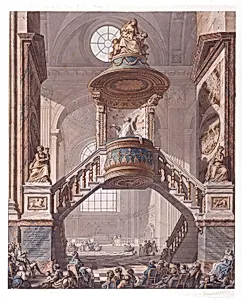
View of the Pulpit, Saint Sulpice, Paris (Second Project)
Classification
architecture
Department
Smithsonian Collection
Museum
Smithsonian American Art Museum
Credit
Purchased for the Museum by the Advisory Council
Accession Number
1911-28-293
Rights
Public Domain
About this artwork
A marble pulpit dramatically suspended between two flights of stairs, designed by de Waily, forms a bridge-like structure across the nave of the Church of Saint Sulpice. A priest, with upraised arms, preaches to the congregation seated in the foreground. A sculpture of Charity adorns the top of the pulpit. A sculpture of Faith (holding a chalice) adorns the left landing; the pedestal shows a bas-relief of the symbol of St. Luke (ox). On the right landing, a sculpture of Hope (holding an anchor) ...
Art Historical Context
Charles de Wailly’s 1789 design for the pulpit at Saint Sulpice captures a bold neoclassical vision for one of Paris’s most important churches. As a leading French architect of the period, de Wailly helped shape the transition from late Baroque exuberance to the restrained grandeur of neoclassicism. This drawing presents his second project for a marble pulpit dramatically suspended between twin staircases, forming a bridge-like platform high above the nave. The composition allows a priest to address the congregation from an elevated, theatrical position while integrating sculpture and architecture into a single, unified statement. The design is enriched by symbolic figures: Charity crowns the pulpit, while Faith (holding a chalice) and Hope (with an anchor) stand on the landings. Bas-reliefs of the ox of Saint Luke and the lion of Saint Mark adorn their pedestals, underscoring the pulpit’s role as a place of sacred teaching. Though the medium of the drawing remains unrecorded, its precise rendering conveys de Wailly’s skill in merging functional architecture with allegorical sculpture. Created on the eve of the French Revolution, the project reflects late-eighteenth-century interest in rational yet spiritually uplifting church interiors. Purchased for the Smithsonian by its Advisory Council, the sheet preserves an ambitious, unrealized moment in the ongoing history of Saint Sulpice.