
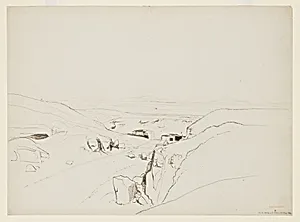
View of the Quarries at Cervara
Medium
Pen and brown ink over traces of graphite
Dimensions
Sheet: 19 1/2 × 26 5/8 in. (49.5 × 67.6 cm)
Classification
Drawings
Department
Drawings and Prints
Museum
Metropolitan Museum of Art, New York, NY
Credit
Purchase, Kristin and Gary Friedman and Karen and Edward Friedman Gifts, in memory of Matthew Rutenberg, 2021
Accession Number
2021.57
Rights
Public Domain
Art Historical Context
Théodore Caruelle dAligny’s *View of the Quarries Cervara* (1834) captures the rugged beauty of ancient stone quarries near Rome, Italy, in a masterful pen and brown ink drawing faint graphite underdrawing. Measuring an impressive 19½ × 26⅝ inches, this large-scale sheet showcases d'Aligny’s skill as a young French artist on the cusp of his illustrious career. Just a year later, he would win the prestigious Prix de Rome, earning a stay at the French Academy in Rome—likely influencing this on-site study of dramatic natural forms and human intervention in the landscape. Rendered with precise, fluid lines and subtle tonal variations from the brown ink, the work exemplifies 19th-century French draughtsmanship, bridging Romantic reverence for nature with emerging realist precision. The quarries at Cervara, sources of travertine for Rome’s iconic architecture, evoke layers of history—from Etruscan origins to imperial grandeur—inviting viewers to ponder time’s sculpting hand. D'Aligny’s technique, layering ink over graphite sketches, allowed for detailed observation, typical of preparatory works that informed his later oil paintings. Acquired by The Metropolitan Museum of Art in 2021 through generous gifts, this drawing highlights the enduring appeal of 19th-century landscape studies, offering a window into an artist’s eye for geology and antiquity. Visitors will appreciate its tactile immediacy, a testament to the pencil-and-ink tradition that paved the way for plein-air modernism.