
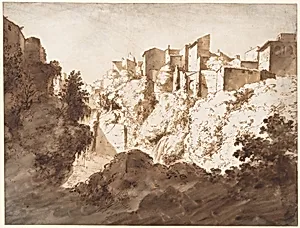
View of Tivoli
early 17th century
Medium
Pen and brown ink, brown wash over traces of black chalk.
Dimensions
12 15/16 x 17 1/16 in. (32.8 x 43.3 cm)
Classification
Drawings
Department
Drawings and Prints
Museum
Metropolitan Museum of Art, New York, NY
Credit
Rogers Fund, 1963
Accession Number
63.2
Rights
Public Domain
Tags
Art Historical Context
Bartholomeus Breenbergh’s *View of Tivoli* captures the timeless allure of the Italian countryside through the eyes of a Dutch artist working in the early seventeenth century. Breenbergh, who traveled to Italy around 1619, was among the first generation of Northern European painters to document the region’s ancient ruins and dramatic landscapes. Tivoli, located east of Rome and famed for its cascading waterfalls and classical sites such as Hadrian’s Villa, became a favorite destination for artists seeking both inspiration and patronage. Executed in pen and brown ink with delicate washes over faint black chalk, the drawing demonstrates Breenbergh’s refined draftsmanship. The fluid lines and subtle tonal gradations evoke the warm Mediterranean light while precisely rendering architectural forms nestled among trees. Such works on paper were not merely preparatory studies but independent works prized by collectors for their intimate, on-the-spot quality. As part of the Metropolitan Museum’s extensive holdings of Dutch and Italianate drawings, this sheet reflects the cultural exchange that shaped European landscape art. Breenbergh’s careful observation helped popularize the Italian countryside as a subject for Northern audiences, bridging classical heritage with the emerging taste for naturalistic scenery.
About the Artist
Bartholomeus Breenbergh · 1598–1657
Probably was apprenticed in Amsterdam. He was one of the early Dutch italianates, that is, northern artists who travelled to Italy in the 1620s and were inspired by southern landscapes. On his return, he settled in Amsterdam and his landscapes were developed as more severe and monumental, often with historical subjects; strongly influenced by the Pre-Rembrandtists. Comment on works: Landscapes; Ru...