
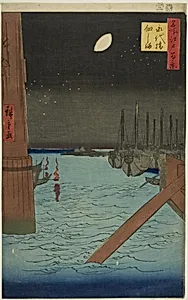
View of Tsukuda Island from Eitai Bridge (Eitaibashi Tsukudajima), from the series "One Hundred Famous Views of Edo (Meisho Edo hyakkei)"
Medium
Color woodblock print; oban
Classification
woodblock print
Department
Arts of Asia
Museum
Art Institute of Chicago
Accession Number
196742
Rights
Public Domain
Art Historical Context
Utagawa Hirosh's *View of Tsukuda Island Eitai Bridge (Eitaibashi Tsukud)*, created in 1857, is a stunning color woodblock print from acclaimed series *One Hundred Views of Edo (Meisho Edo hyakkei)*. This late masterpiece captures the vibrant life of Edo (modern-day Tokyo) during the Edo period, Hiroshige's mastery of ukiyo-e—the "pictures of the floating world" that celebrated everyday beauty, landscapes, and urban scenes. As one of the series' 118 prints (more than planned due to its popularity), it depicts the sweeping vista from the Eitai Bridge toward Tsukudajima, a bustling island famed for its fish markets and eateries, evoking the city's dynamic energy. Hiroshige's artistic genius shines in his innovative use of perspective and atmospheric effects. Printed in the large oban format (roughly 10 x 14 inches), the woodblock technique allowed for bold colors, intricate details, and subtle gradations—achieved through multiple carved blocks and precise color layering. Here, the bridge frames the composition, drawing the eye across the Sumida River to the island's silhouettes against a dramatic sky, blending realism with poetic mood. Housed in the Art Institute of Chicago's Arts of Asia department, this print highlights ukiyo-e's cultural role in democratizing art for the masses. Produced just before Japan's opening to the West, it preserves a vanishing world, influencing later artists like Van Gogh and underscoring Hiroshige's enduring legacy as a bridge between Japanese tradition and global modernism.
About the Artist
Utagawa Hiroshige · 1826–1869
Utagawa Hiroshige (1797–1858), born Andō Tokutarō, was the last great master of Japanese ukiyo-e woodblock printmaking and one of the most influential landscape artists in history. Born in Edo (modern Tokyo) into a low-ranking samurai family serving as fire wardens, Hiroshige transformed landscape printmaking into a poetic meditation on nature, weather, and everyday life. His revolutionary approac...