
Viewing Cherry Blossoms at Goten Hill
c. 1787
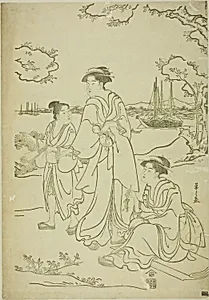
Medium
Woodblock print; right sheet of oban triptych, keyblock proof impression (color sheet: 1925.3091, left sheet: 1939.2195)
Dimensions
38.4 × 26.7 cm (15 1/8 × 10 1/2 in.)
Classification
woodblock print
Department
Arts of Asia
Museum
Art Institute of Chicago
Accession Number
24072
Rights
Public Domain
Art Historical Context
"Viewing Cherry Blossoms Goten Hill" is captivating woodblock print by Chôbunsai Eishi, a master of ukiyo-e from Japan's Edo period, created around 1787. This right sheet of an oban triptych elegant figures savoring hanami—the cherished tradition of cherry blossom viewing—at Goten Hill, evoking the fleeting beauty of spring in urban Edo (modern Tokyo). E, renowned for his bijin-ga (pictures of beautiful women), infuses the scene with graceful poise and refined details, highlighting the era's fascination with leisure and nature. As a keyblock proof impression, this print reveals the intricate groundwork of ukiyo-e production: the black outline carved on a wooden block, printed first to guide subsequent color layers (note the related color sheet and left panel in the collection). Measuring 38.4 × 26.7 cm, its oban format made it accessible to a wide audience, from merchants to samurai, democratizing art in 18th-century Japan. Housed in the Art Institute of Chicago's Arts of Asia department, this proof offers a rare glimpse into the collaborative artistry of woodblock printing—designers, carvers, printers, and publishers working in harmony. It celebrates cultural rituals like hanami, blending seasonal ephemerality with enduring human delight, a hallmark of ukiyo-e's poetic charm.
About the Artist
Chôbunsai Eishi · 1756–1829
Chôbunsai Eishi, born Hosoda Tokitomi in 1756 to a prosperous samurai family of the Fujiwara clan in Edo, inherited a substantial stipend of 500 koku of rice annually. His grandfather had served as the shogunate's Treasury Minister, and upon his father Hosoda Tokiyuki's death in 1772, Eishi became family head while holding a position in Shogun Tokugawa Ieharu's palace from 1781. Unusually for a uk...