
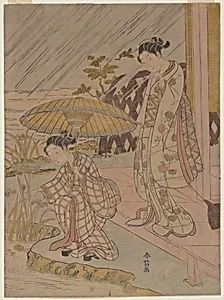
Viewing Iris in the Rain
1764–70
Medium
Woodblock print; ink and color on paper
Dimensions
H. 10 3/4 in. (27.3 cm); W. 7 13/16 in. (19.8 cm)
Classification
Prints
Culture & Period
Japan · Edo period (1615–1868)
Department
Asian Art
Museum
Metropolitan Museum of Art, New York, NY
Credit
H. O. Havemeyer Collection, Bequest of Mrs. H. O. Havemeyer, 1929
Accession Number
JP1649
Rights
Public Domain
Tags
Art Historical Context
In the gentle patter of rain, two elegant women pause to admire blooming irises in Suzuki Harobu's *Viewing Iris in the Rain* (ca. 1764–70), a exquisite woodblock print from Japan's Edo period (16151868). Harunobu, a master of ukiyo-e—the "pictures of the floating world" captured fleeting moments of beauty and urban life—was a pioneer in full-color printing, known as *nishiki-e* or "brocade pictures." This intimate scene exemplifies his signature style: delicate bijin-ga (images of beautiful women) rendered with poetic sensitivity, blending human grace with nature's transience. Crafted from ink and color on paper, the print measures a portable 10¾ × 7⅞ inches, ideal for personal appreciation in the homes of Edo's affluent merchants. Harunobu's innovative technique layered up to 10 colors via separate woodblocks, achieving subtle gradients of misty rain and vibrant floral hues that evoke a serene, melancholic mood. Irises, symbols of valor and literary elegance in Japanese culture, add layers of waka poetry tradition, inviting viewers to savor impermanence. Part of the Metropolitan Museum of Art's H. O. Havemeyer Collection, this work highlights Harunobu's lasting influence on global printmaking, bridging Japan's artistic golden age with modern aesthetics. A quiet gem for rain-lovers and flower enthusiasts alike!
About the Artist
Suzuki Harunobu · 1725–1770
Suzuki Harunobu (c. 1725-1770) was a Japanese ukiyo-e artist who revolutionized woodblock printing by developing nishiki-e—full-color prints using multiple woodblocks—in 1765. Before Harunobu, Japanese prints were limited to two or three colors; his innovation unleashed the entire artist's palette, transforming ukiyo-e into the vibrant art form that would later captivate Western artists from Manet...