
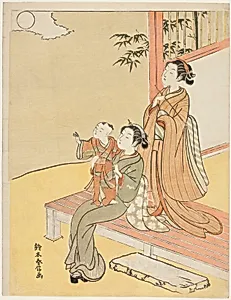
Viewing the Moon
c. 1767/68
Medium
Color woodblock print; chuban
Dimensions
28 × 21.3 cm (11 × 8 3/8 in.)
Classification
woodblock print
Department
Arts of Asia
Museum
Art Institute of Chicago
Accession Number
88997
Rights
Public Domain
Art Historical Context
Suzuki Harunobu's *Viewing the Moon* (c. 1767/68) is a exquisite example of early full-color woodblock printing from Japan's Edo period. Harunobu, a master of the ukiyo-e ("pictures of the floating world") genre, revolutionized printmaking around 1765 by introducing *nishiki-e*—brocade pictures—with vibrant, multi-block colors that captured fleeting moments of beauty, urban life, and nature. This chuban-format print (28 × 21.3 cm), smaller and more intimate than larger formats, was affordable for a growing merchant class audience. Printed using intricate woodblock techniques, where separate blocks were carved for each color and meticulously aligned (*aritsuzuke*), the work showcases Harunobu's delicate lines and subtle gradations. Likely depicting a serene moon-gazing scene—a cherished autumn tradition called *tsukimi*—it evokes poetic tranquility amid everyday elegance. Housed in the Art Institute of Chicago's Arts of Asia department, this print highlights Harunobu's pivotal role in democratizing art, influencing later ukiyo-e giants like Hiroshige and Hokusai. Its cultural resonance lies in celebrating Japan's refined appreciation for seasonal ephemera, inviting viewers to pause and reflect under the moon's glow.
About the Artist
Suzuki Harunobu · 1725–1770
Suzuki Harunobu (c. 1725-1770) was a Japanese ukiyo-e artist who revolutionized woodblock printing by developing nishiki-e—full-color prints using multiple woodblocks—in 1765. Before Harunobu, Japanese prints were limited to two or three colors; his innovation unleashed the entire artist's palette, transforming ukiyo-e into the vibrant art form that would later captivate Western artists from Manet...