
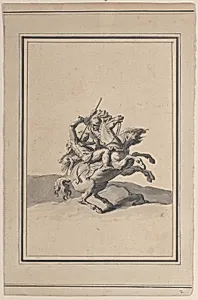
Vignette from the Battle of Milvian
early 18th century
Medium
Pen and black ink, brush and gray wash
Dimensions
Sheet: 5 3/8 × 3 3/4 in. (13.7 × 9.5 cm)
Classification
Drawings
Department
Drawings and Prints
Museum
Metropolitan Museum of Art, New York, NY
Credit
Gift of Richard A. Berman, 2018
Accession Number
2018.844.5
Rights
Public Domain
Tags
Art Historical Context
This delicate vignette captures a dramatic moment from the Battle of the Milvian Bridge in 312 AD, a clash between Roman emperors Constantine and Maxentius along the Tiber River. Rendered in pen and black ink with brush and gray wash, small-scale drawing (just 5 3/8 × 3 3/4 inches) features dynamic figures of men and horses in combat, evoking the chaos of ancient warfare. Attributed to Charles Le Brun the French Baroque master known for his historical scenes at Versailles, and Bernard Picart, a skilled early 18th-century engraver and illustrator, it likely served as a preparatory study for larger prints or tapestries. The Battle of Milvian Bridge holds immense historical significance: Constantine's victory led to his Edict of Milan in 313 AD, granting tolerance to Christians and paving the way for Christianity's dominance in the Roman Empire—famously inspired by his vision of a cross in the sky. Le Brun and Picart's collaboration reflects the era's fascination with classical antiquity, blending meticulous ink lines for precise contours with subtle gray washes to model form and depth, a technique prized in French academic drawing for conveying movement and emotion. Housed in the Metropolitan Museum of Art's Drawings and Prints department as a 2018 gift, this work exemplifies the preparatory artistry behind monumental Baroque narratives, inviting visitors to appreciate how intimate sketches fueled epic storytelling.
About the Artist
Charles Le Brun|Bernard Picart · 1619–1690
Charles Le Brun (1619–1690) was the most powerful artistic figure in seventeenth-century France, serving as the virtual dictator of official taste during the reign of Louis XIV and shaping the visual identity of the French Baroque in ways that resonated for generations. Born in Paris, he trained under the painter Simon Vouet before traveling to Rome in 1642, where he studied the works of Nicolas P...