
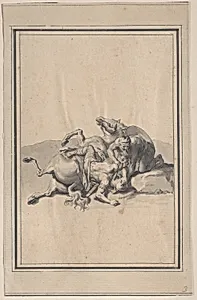
Vignette from the Battle of Milvian
Bernard Picart|Charles Le Brun, early 18th century
About this artwork
Nestled in the Metropolitan Museum of Art's Drawings Prints department, this intimate vignette captures a dramatic moment from the Battle of the Milvian Bridge in 312 AD—a pivotal clash between Roman emperors Constantine and Maxentius along the Tiber River. Attributed to Bernard Picart designs by Charles Le Brun, early 18th-century measures just 5 3/8 × 3 3/4 inches, evoking the intensity of ancient warfare through dynamic figures of men and horses in combat. The Battle of Milvian Bridge profound historical significance: Constantine's victory not only solidified his power but also marked a turning point for Christianity in the Roman Empire, inspired by his famed vision of the Chi-Rho symbol. Le Brun, a leading French Baroque artist and founder of the Royal Academy of Painting and Sculpture, often depicted grand historical and mythological scenes; Picart, a skilled engraver, brought such compositions to life in detailed illustrations. This work likely served as a preparatory study or reproductive drawing, blending Le Brun's dramatic flair with Picart's precision. Crafted in pen and black ink with brush and gray wash, the piece exemplifies 18th-century draftsmanship techniques, where fluid lines and subtle tonal washes create depth and movement on a small scale. Its modest size invites close viewing, revealing the raw energy of battle—perfect for contemplating how artists revived ancient epics to inspire Enlightenment-era audiences. A generous gift from Richard A. Berman in 2018, it reminds us of art's power to bridge eras.