
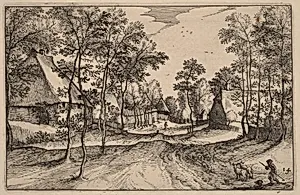
Village Road
Medium
etching
Classification
Department
CG-E
Museum
National Gallery of Art, Washington, D.C.
Credit
Andrew W. Mellon Fund
Accession Number
1975.59.14
Rights
Public Domain
Art Historical Context
Step into the serene world of *Village Road*, an exquisite etching published in 1612 by Claes Jansz Viss. This print traces its origins to a collaborative lineage: Visscher worked after designs by Johannes van Doetechum the Elder and his brother Lucas, who in turn realized the inventive compositions of the anonymous "Master of the Small Landscapes Housed in the National Gallery of Art's Department of Prints (CG-E) through the Andrew W. Mellon Fund, it exemplifies early 17th-century printmaking at its finest. Created during the Northern Renaissance's Golden Age prelude, *Village Road* belongs to the celebrated *Small Landscapes* series from the 1550s–60s, which revolutionized the genre. These modest-scale etchings—intaglio prints where acid etches intricate lines into a metal plate—shifted focus from grand religious scenes to everyday rural vistas. The Doetechum brothers' precise technique captured winding paths, humble villages, and lush fields with remarkable detail, making landscapes accessible and collectible for a burgeoning middle class. This artwork's cultural charm lies in its nostalgic portrayal of Flemish countryside life, blending topography with poetic imagination. It influenced generations of artists, from Rembrandt to later landscapists, highlighting printmaking's power to democratize art and preserve fleeting moments of harmony. A delightful window into 16th-century Europe!