
Ville-d'Avray
c. 1865
Medium
oil on canvas
Dimensions
overall: 49.3 x 65.5 cm (19 7/16 x 25 13/16 in.) framed: 81.3 x 97.5 x 11.6 cm (32 x 38 3/8 x 4 9/16 in.)
Classification
Painting
Department
CF
Museum
National Gallery of Art, Washington, D.C.
Credit
Gift of Count Cecil Pecci-Blunt
Accession Number
1955.9.1
Rights
Public Domain
Art Historical Context
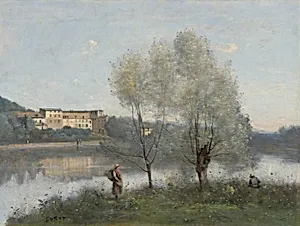
Jean-Baptiste-Camille Corot’s *Ville-d’Avray* (c. 1865) captures a tranquil suburban scene outside Paris in the artist’s characteristically poetic style. A leading figure the Barbizon school, Corot helped shift French landscape painting toward direct observation of nature while retaining a romantic sensitivity to light and atmosphere. By the mid-1860s he had already achieved recognition, and works such as this one reflect his mature approach—soft, silvery tones and gently blurred forms that evoke memory as much as precise topography. Painted in oil on canvas, the medium allowed Corot to build luminous layers and delicate transitions between sky, foliage, and water. The modest scale (roughly 49 by 66 cm) suggests an intimate, personal view rather than a grand exhibition piece, inviting quiet contemplation. Acquired by the National Gallery of Art as a gift from Count Cecil Pecci-Blunt, the painting now offers visitors a window onto both the French countryside of the Second Empire and the artistic innovations that would soon inspire the Impressionists.
About the Artist
Jean-Baptiste-Camille Corot · 1796–1875
Jean-Baptiste-Camille Corot, born on July 16, 1796, in Paris to a prosperous bourgeois family—his father a former wig-maker turned draper and his mother a successful milliner—was initially apprenticed in the textile trade but pursued art from his mid-twenties with family support. He studied under the neoclassical landscapist Achille Etna Michallon in 1821–1822, who taught him to sketch outdoors in...