
Violet Girl
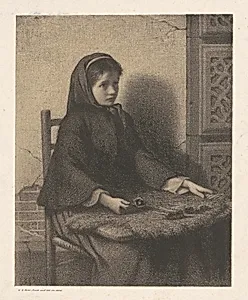
Medium
lithograph in black with tan stone tint on wove paper
Dimensions
image: 24.77 × 19.69 cm (9 3/4 × 7 3/4 in.) sheet: 38.26 × 31.12 cm (15 1/16 × 12 1/4 in.)
Classification
Department
CG-W
Museum
National Gallery of Art, Washington, D.C.
Credit
Corcoran Collection (Gift of Alice F. Williams)
Accession Number
2015.19.916
Rights
Public Domain
Art Historical Context
William Morris Hunt's "Violet Girl," created in 1857, offers a charming glimpse into mid-nineteenth-century American printmaking. Executed as a lithograph in black with a delicate tan stone tint on wove paper, the work measures just under ten inches in image size, giving it an intimate quality suited to personal contemplation. Hunt, an artist who bridged American and European traditions, used lithography's fluid lines and tonal possibilities to capture the quiet presence of his youthful subject. Lithography was then a relatively new reproductive medium that allowed artists to reach broader audiences beyond the elite circles of painting collectors. The addition of a tinted stone adds warmth and depth, enhancing the figure's soft contours without overwhelming the composition's simplicity. This technique reflects the era's growing interest in accessible art forms that combined technical precision with expressive subtlety. Now part of the National Gallery of Art's Corcoran Collection, "Violet Girl" stands as a fine example of how prints helped shape public appreciation of art in the United States. Its modest scale and refined execution continue to invite viewers to pause and consider the quiet stories held within nineteenth-century graphic works.
About the Artist
William Morris Hunt · 1824–1879
American, Brattleboro, Vermont 1824–1879 Appledore, New Hampshire