
Violin
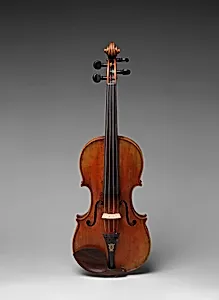
Medium
Pine, maple, ebony
Dimensions
Total Length: 59.5 cm (23-1/8 in.) Length of Body: 35.7 cm (141/8 in.) Depth. at edge: 3.9 cm (1-5/8 in.) Upper bout: 16.3 cm (6-1/2 in.) Center bout: 10.5 cm (4-1/8 in.) Lower bout: 20.2 cm (8 in.) Length of fingerboard: 27.3 cm (10-3/4 in.) Greatest width of fingerboard: 4.6 cm (1-7/8 in.) Vibrating length of strings: 33.1 cm (13-1/8 in.)
Classification
Chordophone-Lute-bowed-unfretted
Culture
American
Department
Musical Instruments
Museum
Metropolitan Museum of Art, New York, NY
Credit
Gift of A. Gemunder & Sons, 1945
Accession Number
45.71.1
Rights
Public Domain
Art Historical Context
Crafted in 1893 by August Martin Gemünder, a renowned-born luthier who established a prominent violin-making dynasty in New York City, violin exemplifies 19th-century American craftsmanship by classical European traditions. Gemünder, whose family firm A. Gemünder & gifted the instrument to the Metropolitan Museum of in 1945, drew from the designs of masters like Stradivari, Old World precision with New World innovation. Measuring 59.5 cm in total length with a body of 35.7 cm, it adheres to standard full-size proportions, ensuring optimal playability and tone. The violin's construction highlights masterful lutherie techniques: a pine (spruce) top for its resonant clarity, maple back and ribs for warmth and projection, and ebony fingerboard for durability under string tension. These woods, chosen for their acoustic properties, vibrate harmoniously—the vibrating string length of 33.1 cm producing the rich timbre expected of a chordophone-lute-bowed-unfretted instrument. As a cultural artifact, it reflects the booming American musical scene of the Gilded Age, where immigrant artisans elevated violin making to fine art, supplying orchestras and virtuosos alike. Visitors, imagine this violin's strings singing in a gilded concert hall— a testament to Gemünder's legacy in bridging continents through sound.