
Violin Bow
Unknown Artist
mid-19th century
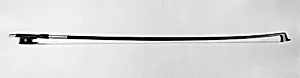
Medium
Pernambuco, leather, ivory, ebony, silver, mother-of-pearl, horsehair
Dimensions
Length of stick 73.2 cm (28-13/16 in.) Length of hair 65.3 cm (25-13/16 in.) Weight 57.6 gm.
Classification
Chordophone-Accessories-bow
Culture
French
Department
Musical Instruments
Museum
Metropolitan Museum of Art, New York, NY
Credit
Bequest of William Winternitz, 1991
Accession Number
1991.28.4
Rights
Public Domain
Art Historical Context
This elegant violin bow, crafted in mid-19th-century France an unknown artist, exemplifies pinnacle of lutherie craftsmanship during the Romantic era. Measuring 73.2 cm in stick length and weighing a precise 57.6 grams, it features a stick of pernambuco—a dense, resilient Brazilian wood prized for its strength, elasticity, and ability to produce a clear, powerful tone. The frog, likely made of ebony with silver mounts and mother-of-pear inlays, is wrapped in leather for grip, while ivory accents and horsehair bowing complete its luxurious construction. In the French bow-making tradition, inspired by François Tourte's early 19th-century innovations, this accessory transformed violin performance. Pernambuco's springy quality allowed for greater bow control and expression, enabling virtuosos like Paganini to push musical boundaries. As a chordophone accessory, it was essential for string players, bridging artistry and engineering in an age when orchestral music flourished across Europe. Bequeathed to the Metropolitan Museum of Art in 1991 by William Winternitz, this bow invites visitors to appreciate the unsung heroes of classical music—tools that shaped soundscapes still heard today.