
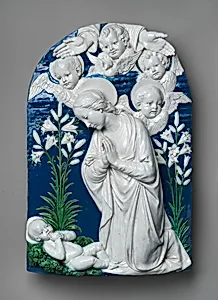
Virgin Adoring the Christ Child
after 1479
Medium
Glazed terracotta
Dimensions
Overall: 29 1/2 × 20 1/16 × 5 in. (74.9 × 51 × 12.7 cm); Framed: 38 1/4 in. × 28 3/4 in. × 5 in. (97.2 × 73 × 12.7 cm)
Classification
Sculpture
Culture
Italian, Florence
Department
European Sculpture and Decorative Arts
Museum
Metropolitan Museum of Art, New York, NY
Credit
Bequest of Adele L. Lehman, in memory of Arthur Lehman, 1965
Accession Number
65.181.23
Rights
Public Domain
Tags
Art Historical Context
In the late 15th century, buzzed with Renaissance innovation, and Andrea della Rob, nephew of the pioneering sculptor Luca della Robbia, forward the family legacy. Created after 1479, *Virgin Adoring the Christ* exemplifies their signature glazed terracotta technique—a durable, weather-resistant medium perfected in the Della Robbia workshop. tin-glazed earthenware allowed for vivid, jewel-like colors that mimicked painting while offering the permanence of sculpture, making it ideal for both indoor altarpieces and outdoor church decorations. The artwork tenderly captures a quintessential devotional scene: the Virgin Mary in quiet adoration of the infant Christ, surrounded by angels and delicate flowers symbolizing purity and divine grace. Measuring nearly 30 inches tall, its soft modeling and luminous glazes—typically whites, blues, and golds—convey spiritual serenity and humanism, blending Gothic tenderness with emerging Renaissance naturalism. Such reliefs were beloved in Florentine homes and chapels, fostering personal piety amid the era's religious fervor. Today, housed in the Metropolitan Museum of Art's European Sculpture and Decorative Arts collection (bequest of Adele L. Lehman, 1965), this piece highlights Italian Renaissance craftsmanship and the enduring appeal of Marian iconography, inviting visitors to ponder the intimate humanity of sacred figures.
About the Artist
Andrea della Robbia · 1435–1525
Andrea della Robbia was one of the most successful and prolific of the della Robbia family. He trained with his uncle, Luca della Robbia, assisting in his workshop, and by 1470, had assumed its supervision. Typically, his works are more complex than Luca's, with more expressive figures and compositions. He worked on many commissions during the 1470s, and also began a series of tin-glazed terracott...