
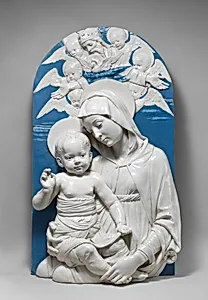
Virgin and Child
ca. 1470–75
Medium
Glazed terracotta
Dimensions
37 3/8 x 21 5/8 in. (94.9 x 54.9 cm)
Classification
Sculpture
Culture
Italian, Florence
Department
European Sculpture and Decorative Arts
Museum
Metropolitan Museum of Art, New York, NY
Credit
Gift of Edith and Herbert Lehman Foundation Inc., 1969
Accession Number
69.113
Rights
Public Domain
Tags
Art Historical Context
Step into the radiant world of Renaissance Florence with Andrea della Robbia's * and Child* (ca. 1470–75), a masterful glazed terracotta sculpture now gracing the Metropolitan Museum of's European Sculpture and Decor Arts collection. Standing nearly three feet tall, this devotional image captures the tender bond between the Virgin Mary and the Christ Child, a beloved motif in Italian art symbolizing divine motherhood and humanity's hope. Andrea, nephew of the pioneering Luca della Robbia, the family's signature technique: firing terracotta coated in vibrant, tin-based glazes that endure outdoors while glowing with jewel-like color—often whites, blues, and golds against a serene backdrop. Created in Florence during the height of the Early Renaissance, this relief exemplifies the city's artistic fervor, blending Gothic piety with emerging naturalism in Mary's gentle gaze and the Child's playful gesture. Its cultural importance lies in its role as both private prayer aid and public adornment, reflecting Florence's devotion to the Madonna amid economic prosperity and artistic innovation. Gifted to the Met in 1969 by the Edith and Herbert Lehman Foundation, it invites us to ponder the enduring spirituality of 15th-century Italy.
About the Artist
Andrea della Robbia · 1435–1525
Andrea della Robbia was one of the most successful and prolific of the della Robbia family. He trained with his uncle, Luca della Robbia, assisting in his workshop, and by 1470, had assumed its supervision. Typically, his works are more complex than Luca's, with more expressive figures and compositions. He worked on many commissions during the 1470s, and also began a series of tin-glazed terracott...