
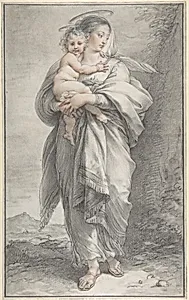
Virgin and Child
1750–99
Medium
Black and red chalk, stumping throughout
Dimensions
15 3/16 x 9 7/16in. (38.6 x 23.9cm)
Classification
Drawings
Department
Drawings and Prints
Museum
Metropolitan Museum of Art, New York, NY
Credit
Harry G. Sperling Fund, 1992
Accession Number
1992.68
Rights
Public Domain
Tags
About this artwork
Giuseppe Cades's "Virgin and Child" (1750–99) The work, executed in black and red chalk, stumping throughout, measures 15 3/16 x 9 7/16in. and Prints served crucial roles in disseminating artistic ideas and images across geographic and social boundaries. This work provides valuable insights into Giuseppe Cades's artistic practice and the broader cultural and material contexts of its creation.
Art Historical Context
Giuseppe Cades’s *Virgin and Child* captures the tender intimacy of the Madonna and Child, a theme that has resonated through centuries of European art. Created between 1750 and 1799, this drawing reflects the enduring appeal of devotional subjects during the late eighteenth century, when artists continued to explore traditional religious imagery even as new artistic currents emerged. Executed in black and red chalk with extensive stumping, the work demonstrates Cades’s skillful handling of soft, blended tones to model forms and create a sense of warmth and volume. Drawings like this one played an important role in an artist’s studio practice, serving both as preparatory studies and as independent works that could be appreciated for their technical beauty and emotional expressiveness. Now part of the Metropolitan Museum’s collection of drawings and prints, this sheet offers visitors a glimpse into Cades’s artistic process and the rich material traditions of the period. Its sensitive rendering invites quiet contemplation, connecting today’s viewers with the long history of depicting the sacred bond between mother and child.