
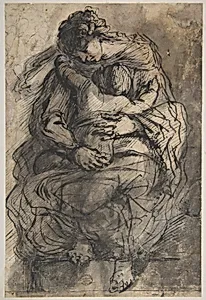
Virgin and Child
1574–1625
Medium
Pen and black ink, brush and gray wash
Dimensions
10 1/4 × 6 7/8 in. (26.1 × 17.5 cm)
Classification
Drawings
Department
Drawings and Prints
Museum
Metropolitan Museum of Art, New York, NY
Credit
Rogers Fund, 1912
Accession Number
12.56.9
Rights
Public Domain
Tags
Art Historical Context
Behold the tender "Virgin and Child," a delicate drawing by Giulio Cesare Procaccini (1574–1625), a leading Lombard artist whose work bridged late Mannerism and the emerging Baroque style. Rendered in pen and black with brush and gray wash on—measuring just 10¼ × 6⅞ inches—this intimate study captures the Virgin Mary cradling the infant, a timeless devotional motif central to Christian art. Procaccini's fluid lines and subtle gray washes masterfully model the figures' soft forms and gentle expressions, evoking emotional depth and serenity. Such techniques were hallmarks of 17th-century Italian draftsmanship, often used for preparatory sketches that informed larger paintings or sculptures, showcasing an artist's mastery of light, shadow, and anatomy before committing to canvas or marble. Acquired through the Rogers Fund in 1912 and now in the Metropolitan Museum of Art's Drawings and Prints department, this piece highlights the cultural reverence for Marian imagery during the Counter-Reformation era, inviting visitors to appreciate the quiet power of a mother's love rendered in humble ink.
About the Artist
Giulio Cesare Procaccini · 1574–1625
Painter and sculptor, son of Ercole Procaccini. Having moved to Milan with the rest of the family in the mid-1580s, he trained as a sculptor, perhaps in the workshop of Francesco Brambilla (ii), and then worked (1591–9) for the workshop of Milan Cathedral. Italian painter, printmaker.