
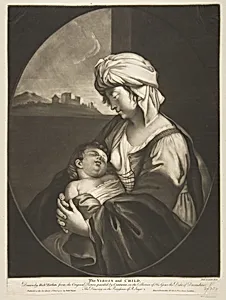
Virgin and Child
Medium
Mezzotint
Dimensions
Sheet: 14 13/16 x 10 7/8 in. (37.7 x 27.7 cm)
Classification
Prints
Department
Drawings and Prints
Museum
Metropolitan Museum of Art, New York, NY
Credit
The Elisha Whittelsey Collection, The Elisha Whittelsey Fund, 1951
Accession Number
51.501.2997
Rights
Public Domain
Tags
Art Historical Context
Behold the serene *Virgin and Child*, captivating mezzotint print from 1772, now housed in the Metropolitan Museum Art's Drawings and Prints. Originally derived from a composition by the 17th-century Italian Baroque Simone Cantarini—a master of the Bolognese school influenced by Guido Reni—this tender depiction of the Madonna cradling the infant Jesus evokes profound maternal devotion and spiritual grace. Cantarini's elegant figures, with their soft modeling and luminous drapery, were ideally suited for reproduction in print form. Crafted by a collaborative team of British printmakers—Robert Laurie, Robert Sayer, and Richard Earlom—using the innovative mezzotint technique, this work exemplifies 18th-century reproductive printmaking. Mezzotint, pioneered in the 17th century, involves roughening a copper plate to create velvety blacks and subtle gradations of tone, allowing for painterly depth unmatched by earlier intaglio methods. At 14 13/16 x 10 7/8 inches, its generous sheet size made it accessible to a wide audience, from collectors to the devout. This Madonna and Child motif, a cornerstone of Christian iconography, underscores the enduring cultural reverence for the sacred mother-son bond. Acquired through The Elisha Whittelsey Fund in 1951, it invites visitors to appreciate how prints bridged art and devotion across centuries, preserving Cantarini's legacy in an age of Enlightenment curiosity.
About the Artist
Simone Cantarini|Robert Laurie|Robert Sayer|Richard Earlom · 1612–1648
He was one of the most eminent pupils of Guido Reni and one of the most gifted engravers in the tradition of the Carracci. He had a strong personality and developed a highly original style, which united aspects of Bolognese classicism with a bold naturalism. Comment on works: Religious