
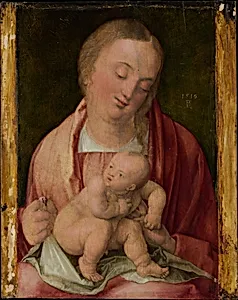
Virgin and Child
1516
Medium
Oil on spruce
Dimensions
11 x 7 3/8 in. (27.9 x 18.7 cm); set in panel 11 x 8 1/4 in. (27.9 x 22.2 cm)
Classification
Paintings
Department
European Paintings
Museum
Metropolitan Museum of Art, New York, NY
Credit
Gift of J. Pierpont Morgan, 1917
Accession Number
17.190.5
Rights
Public Domain
Tags
Art Historical Context
Albrecht Dürer’s *Virgin and Child (1516) is tender devotional painting that captures the intimate bond between mother and infant. Created in the artist’s native Nuremberg during the height of the Northern Renaissance, this small oil on spruce panel reflects Dürer’s masterful ability to blend meticulous northern European detail with the balanced harmony he admired in Italian art. Though best known for his groundbreaking prints, Dürer also produced sensitive religious paintings that invited personal contemplation. Measuring just eleven inches tall, the work was likely intended for private prayer rather than a church altar. The Madonna and Child theme, one of the most enduring subjects in Christian art, here emphasizes quiet affection over grandeur. Painted on spruce—a wood favored in German-speaking regions for its smooth surface—Dürer used oil’s luminous qualities to render soft flesh tones and delicate drapery with remarkable precision. Acquired by the Metropolitan Museum through the generosity of J. Pierpont Morgan, this compact masterpiece demonstrates how Dürer elevated even the smallest formats into profound statements of faith and human warmth.
About the Artist
Albrecht Dürer · 1471–1528
Albrecht Dürer (1471–1528) stands as the preeminent figure of the Northern Renaissance and arguably the most influential artist in the history of printmaking. Born in Nuremberg on May 21, 1471, and dying in the same city on April 6, 1528, Dürer revolutionized the status of the artist in Northern Europe, transforming printmaking from a commercial craft into an independent fine art and establishing ...