
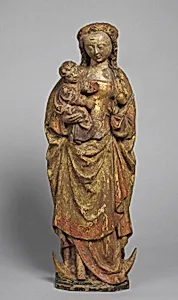
Virgin and Child
Unknown Artist
early 16th century
Medium
Oak, painted and gilded
Dimensions
Overall: 14 3/8 x 4 7/8 x 2 3/8 in. (36.5 x 12.4 x 6 cm)
Classification
Sculpture-Wood
Culture
South Netherlandish
Department
Medieval Art
Museum
Metropolitan Museum of Art, New York, NY
Credit
Gift of J. Pierpont Morgan, 1916
Accession Number
16.32.297
Rights
Public Domain
Art Historical Context
Nestled in the Metropolitan Museum of Art's Medieval collection, this intimate *Virgin and Child* sculpture, crafted by an unknown South Netherlandish artist in early 16th century captures the tender devotion central to Christian piety during the Northern Renaissance. Carved from oak and adorned with vibrant paints and gold leaf, the 14 3/8-inch tall figure depicts the Madonna cradling the Christ Child, a ubiquitous motif symbolizing maternal love and divine incarnation. Its modest dimensions—14 3/8 x 4 7/8 x 2 3/8 inches—suggest it was designed for private worship, perhaps in a home or small chapel, rather than a grand cathedral. South Netherlandish workshops excelled in such polychrome wood sculptures, blending Gothic realism with emerging Renaissance naturalism. The use of durable oak allowed for intricate detailing, while the painted and gilded surfaces brought ethereal glow and lifelike color, enhancing spiritual presence through light play on the gold. This technique, rooted in late medieval traditions, made sacred figures accessible and emotionally resonant for the faithful. A generous gift from J. Pierpont Morgan in 1916, this piece exemplifies the region's artistic legacy, offering visitors a glimpse into the heartfelt religious art that shaped daily devotion in early modern Europe.