
Virgin and Child
Unknown Artist
ca. 1300
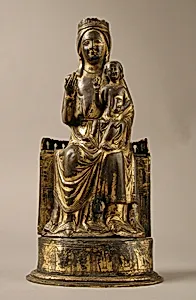
Medium
Copper-gilt, champlevé enamel, glass bead
Dimensions
Overall: 8 7/8 x 4 9/16 x 3 5/16in. (22.5 x 11.6 x 8.4cm)
Classification
Enamels-Champlevé
Culture
French
Department
Medieval Art
Museum
Metropolitan Museum of Art, New York, NY
Credit
Gift of J. Pierpont Morgan, 1917
Accession Number
17.190.348
Rights
Public Domain
Art Historical Context
This exquisite *Virgin and Child*, in France around 1300, exemplifies the art of the High Gothic period Standing just under 9 inches tall, small-scale sculpture was likely designed for private prayer or as an altar piece in a noble household or chapel. The tender depiction of the Virgin Maryling the Christ Child reflects the era's deep Marian devotion, emphasizing her role as protector and intercessor medieval Christian piety. The artwork's brilliance comes from its masterful use of champlevé enamel a copper-gilt base,ented by a glass bead. Champlevé a hallmark technique of 12th- to 14-century French workshops—particularly those in Limoges—involved troughs into the metal, filling them with powdered glass enamels, and firing them to create vibrant, durable colors. This method produced luminous, jewel-like surfaces that mimicked stained glass or precious gems, making religious icons accessible yet opulent for the faithful. A generous gift from J. Pierpont Morgan to The Metropolitan Museum of Art in 1917, this anonymous masterpiece survives as a testament to medieval craftsmanship, inviting us to ponder the spiritual intimacy it once fostered.