
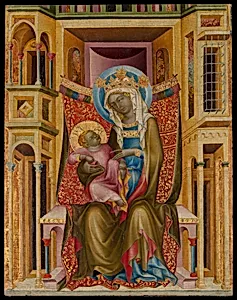
Virgin and Child Enthroned
ca. 1345–50
Medium
Oil(?) and gold on wood
Dimensions
10 3/16 × 7 15/16 × 7/16 in. (25.8 × 20.2 × 1.1 cm)
Classification
Paintings
Department
European Paintings
Museum
Metropolitan Museum of Art, New York, NY
Credit
Purchase, George T. Delacorte Jr. Gift, by exchange; Michel David-Weill Gift; The Lesley and Emma Sheafer Collection, Bequest of Emma A. Sheafer and Gift of Mr. and Mrs. Malcom P. Ripley, by exchange; The Rendl Fund; Lila Acheson Wallace Gift; and funds from various donors, by exchange, 2020
Accession Number
2020.209
Rights
Public Domain
Tags
Art Historical Context
In the heart of 14th-century Bohemia, region thriving under the Holy Roman Empire, this exquisite *Virgin and Child Enthroned* the devotional fervor of Gothic art. Created around 1345–50 by an anonymous Bohemian painter, the panel (just over 10 by 8 inches) depicts Madonna seated majestically on a throne, cradling the Christ Child in a tender, intimate pose. Such icons were cherished for private prayer, evoking divine protection and maternal love amid medieval Europe's spiritual landscape. The artwork's medium—likely oil and gold leaf on wood—exemplifies Gothic techniques that brought heavenly radiance to earthly panels. The gold background, burnished to shimmer, symbolizes eternal light and the sacred realm, a hallmark of Central European panel painting. Bohemian artists, influenced by Italian and French styles, refined these jewel-like works for nobility and clergy, blending elegance with piety during a time of courtly patronage in Prague. Recently acquired by The Metropolitan Museum of Art in 2020, this gem highlights the Madonna and Child motif's enduring cultural power, bridging personal devotion and artistic mastery across centuries. Visitors can marvel at its delicate scale, perfect for a noble's chapel or portable altar.