
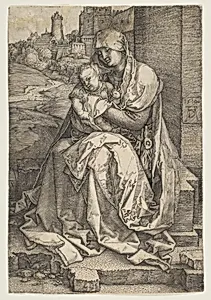
Virgin and Child Seated by the Wall
1514
Medium
Engraving
Dimensions
Sheet: 5 3/4 × 3 7/8 in. (14.6 × 9.9 cm)
Classification
Prints
Department
Drawings and Prints
Museum
Metropolitan Museum of Art, New York, NY
Credit
The George Khuner Collection, Gift of Mrs. George Khuner, 1968
Accession Number
68.793.30
Rights
Public Domain
Tags
Art Historical Context
In the intimate engraving *Virgin and Child Seated by the Wall* (1514), Albrecht Dürer captures a tender moment of maternal devotion, a quintessential Madonna and Child motif in Northern Renaissance art. Created when Dürer was at the height of his mastery, this small-scale work (5 3/4 × 3 7/8 in.) exemplifies his revolutionary approach to printmaking. The Virgin Mary, seated humbly against a plain wall, cradles the Christ Child with quiet grace, her serene expression inviting contemplation. Dürer's engraving technique—incising precise lines into a copper plate—allowed for unprecedented detail and tonal subtlety, making high art accessible beyond elite patrons. Influenced by his Italian journeys, he blended Northern precision with Renaissance humanism, evident in the delicate folds of Mary's robe and the child's naturalistic pose. This print, from The Metropolitan Museum of Art's George Khuner Collection, reflects the era's devotional fervor amid the Protestant Reformation's stirrings. A testament to Dürer's genius, it was designed for personal piety, easily reproduced and cherished in homes across Europe. Visitors, marvel at how such a modest sheet conveys profound spiritual depth.
About the Artist
Albrecht Dürer · 1471–1528
Albrecht Dürer (1471–1528) stands as the preeminent figure of the Northern Renaissance and arguably the most influential artist in the history of printmaking. Born in Nuremberg on May 21, 1471, and dying in the same city on April 6, 1528, Dürer revolutionized the status of the artist in Northern Europe, transforming printmaking from a commercial craft into an independent fine art and establishing ...