
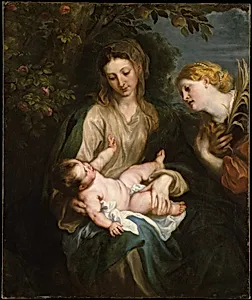
Virgin and Child with Saint Catherine of Alexandria
ca. 1630
Medium
Oil on canvas
Dimensions
43 x 35 3/4 in. (109.2 x 90.8 cm); with added strips 44 1/8 x 37 in. (112.1 x 94 cm)
Classification
Paintings
Department
European Paintings
Museum
Metropolitan Museum of Art, New York, NY
Credit
Bequest of Lillian S. Timken, 1959
Accession Number
60.71.5
Rights
Public Domain
Tags
Art Historical Context
In the serene glow of Anthony van Dyck's *Virgin and Child with Saint of Alexandria* (ca. 1630), the Flemish Baroque master captures a tender moment of divine intimacy. The Virgin Mary cradles the Christ Child, who reaches playfully toward Saint Catherine, the learned martyr often symbolized by her spiked wheel (though not visible here). This oil-on-canvas devotional scene, measuring about 43 x 35¾ inches originally, exemplifies the Counter-Reformation era's emphasis on accessible, emotionally resonant religious imagery to inspire faith among the faithful. Van Dyck, a protégé of Peter Paul Rubens and fresh from his formative years in Italy, infuses the work with his signature elegance: luminous flesh tones, flowing drapery, and dramatic chiaroscuro that heightens the figures' grace and spirituality. His bravura brushwork in oils creates a velvety texture, drawing viewers into the sacred circle. Painted during his Antwerp maturity, it reflects the opulent Flemish tradition while echoing Venetian influences like Titian. Bequeathed to the Metropolitan Museum of Art by Lillian S. Timken in 1959, this painting—later enlarged with added strips—remains a gem of European religious art, inviting contemplation of maternal love and saintly devotion in an age of artistic splendor.
About the Artist
Anthony van Dyck · 1599–1641
Sir Anthony van Dyck (1599-1641) was a Flemish Baroque artist who revolutionized portrait painting and became the most influential court painter in 17th-century England. Born in Antwerp as the seventh of twelve children to a prosperous silk merchant, van Dyck displayed extraordinary artistic talent from childhood. He trained under Hendrick van Balen before joining Peter Paul Rubens's workshop as a...