
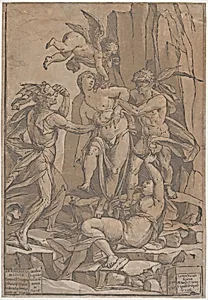
Virtue as a young woman surrounded by four figures representing love, error, ignorance and opinion
Andrea Andreani|Jacopo Ligozzi, 1585
About this artwork
In the late Renaissance era, around 1585, Italian artists Andrea Andreani and Jacopo Ligozzi collaborated this striking chiaroscuro woodcut a masterful print that elevates woodblock printing to painterly heights. Andreani, a pioneering specialist in chiaroscuro techniques from Bologna, printed the image from an extraordinary four blocks using brown ink, creating dramatic light and shadow effects that mimic oil paintings. Ligozzi, a Florentine court artist known for his intricate drawings, likely provided the design, infusing it with Mannerist elegance and allegorical depth. At the center stands Virtue personified as a poised young woman, encircled by four symbolic figures—Love, Error, Ignorance, and Opinion—representing the temptations and follies that challenge moral integrity. This composition draws from classical and Christian traditions, common in 16th-century Italian art, where personifications warned viewers of virtue's precarious path amid human frailties. Nude figures add a sensual yet cautionary tone, echoing Renaissance ideals of beauty intertwined with ethical lessons. Measuring nearly 19 by 13 inches, this rare four-block chiaroscuro exemplifies technical innovation, allowing nuanced tonal modeling rarely seen in prints of the time. Acquired by The Metropolitan Museum of Art in 1928, it showcases how prints democratized complex allegories, bridging elite painting with wider audiences in an age of intellectual and artistic fervor.