
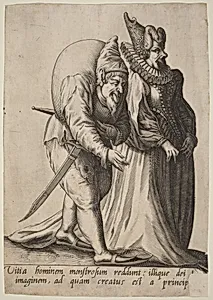
Vitia hominem monstrosum...
Medium
engraving
Dimensions
sheet: 19.8 x 14 cm (7 13/16 x 5 1/2 in.)
Classification
Department
CG-E
Museum
National Gallery of Art, Washington, D.C.
Credit
Gift of the Estate of Leo Steinberg
Accession Number
2011.139.112
Rights
Public Domain
Art Historical Context
Step into the intricate world of late Renaissance emblematic art with *Vitia hominem monstum...* (1597), an engraving by Robert Boissard after designs by his father, the scholar and poet Jean-Jacques Boissard This small yet potent print, measuring just 19.8 x cm, captures the era fascination with moral allegory, where vices are vividly personified as a monstrous human figure. The Latin title, translating roughly to "Vices make monstrous," underscores a humanist critique of human flaws, blending grotesque imagery with didactic intent. Engraving, the medium here, was a revolutionary technique in the 16th century, allowing artists like Robert Boissard to reproduce finely detailed designs with precision and tonal depth through incised metal plates. Boissard's work draws from his father's emblem books—popular illustrated collections pairing cryptic images with mottos to impart ethical lessons. Produced in 1597, amid Europe's intellectual ferment, this piece reflects the transition from Renaissance humanism to emerging Baroque drama, using hybrid forms to warn against moral decay. Housed in the National Gallery of Art as a gift from the Estate of Leo Steinberg, this print invites visitors to ponder timeless vices through artistic ingenuity. Its compact scale belies its cultural punch, exemplifying how prints democratized complex ideas for a wide audience.